Tongkat Ali: What the Human Trials Actually Show
Quick Answer: Does Tongkat Ali Work?
For stress and energy, the evidence is reasonable. A four-week trial in moderately stressed adults found a 16% reduction in cortisol and improvements in tension, anger and confusion scores. For testosterone, the picture is weaker: increases show up fairly consistently in men with low baseline levels, and much less clearly in men whose levels are already normal. It is the best-supported botanical in most male vitality blends — which says as much about the category as it does about tongkat ali.
- Strongest finding: lower cortisol and better mood under stress.
- Trial dose: 200–400 mg daily of a standardised water extract.
- Timeline: four to twelve weeks in most studies.
What tongkat ali is
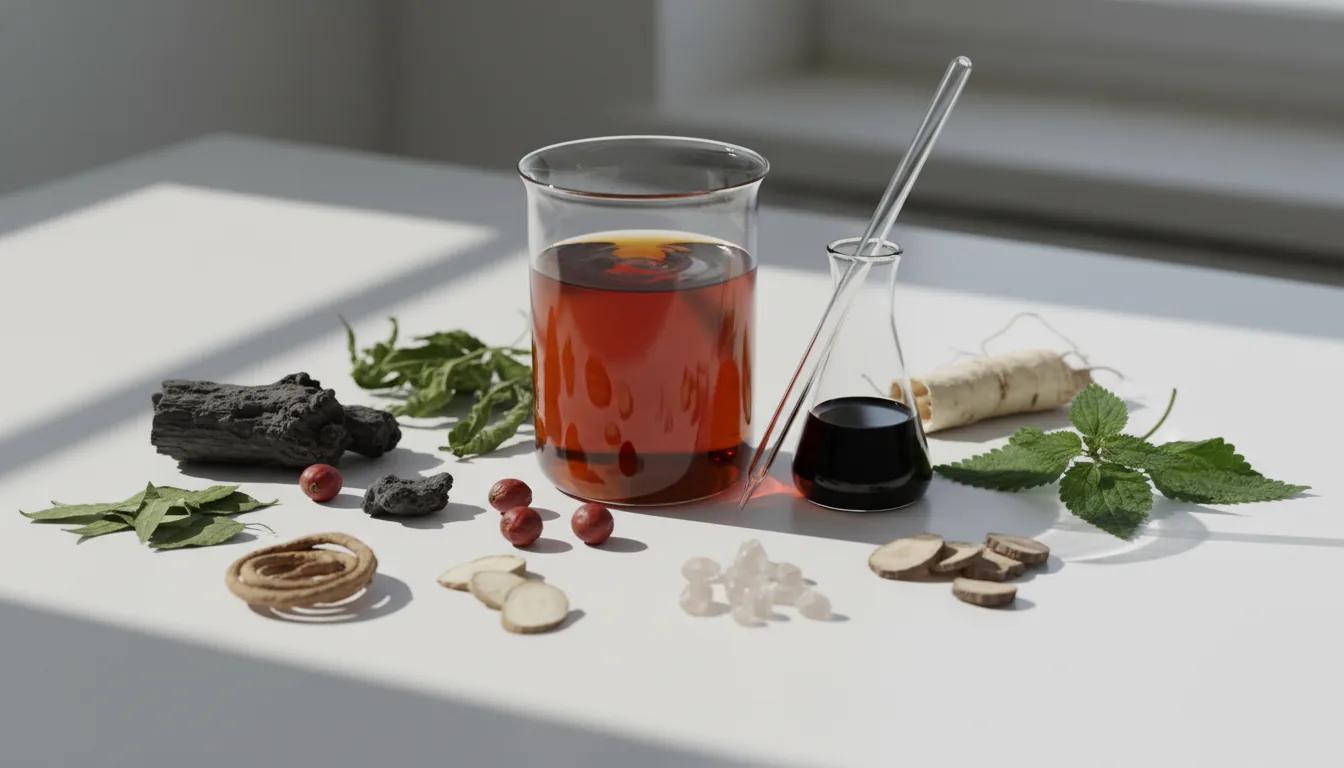
Eurycoma longifolia is a shrub native to Malaysia, Indonesia and Thailand, where the root has been used in traditional medicine for generations. In supplements it appears as a water extract, typically standardised and labelled with a ratio such as 100:1 or 200:1 — meaning the stated weight of extract represents that multiple of raw root.
That ratio matters more than it looks. A 200 mg dose of a 100:1 extract and 200 mg of unstandardised root powder are not remotely the same product, and trials were run on the former.
The cortisol evidence — the part that holds up
The most cited human study is Talbott and colleagues, published in 2013 in the Journal of the International Society of Sports Nutrition. Sixty-three moderately stressed adults took 200 mg daily of a standardised water extract for four weeks. The group showed a roughly 16% reduction in salivary cortisol and a 37% increase in salivary testosterone, alongside improvements on tension, anger and confusion subscales.
It is a genuine, placebo-controlled result. It is also small, short and run on a specific extract. One study of 63 people over four weeks is a reasonable signal, not a settled conclusion — and the honest way to read it is that tongkat ali plausibly helps people whose fatigue is stress-driven.
The testosterone evidence — where it thins
This is where marketing outruns data. Reviews consistently find that tongkat ali's effect on testosterone depends heavily on who is taking it. In men with hypogonadism or otherwise low baseline levels, several small studies report meaningful increases. In healthy men with normal levels, results are inconsistent and often null.
That pattern is common across the whole "testosterone booster" category, and it has a mundane explanation: it is far easier to move a number that has fallen below normal than one already sitting inside the reference range.
| Outcome | Evidence quality | Honest summary |
|---|---|---|
| Cortisol / stress | Reasonable | Placebo-controlled human data, small sample, short duration |
| Mood and energy | Reasonable | Self-reported measures, consistent direction |
| Testosterone (low baseline) | Moderate | Several small studies, generally positive |
| Testosterone (normal baseline) | Weak | Inconsistent, frequently null |
| Erectile function | Insufficient | Not an appropriate use; see a doctor |
Dose, and the blend problem
Trials cluster around 200–400 mg per day of a standardised extract. That is the number to compare any product against — and it is precisely the comparison most blended formulas make impossible.
When a label declares a "proprietary blend, 1,200 mg" containing seven botanicals, you cannot know whether the tongkat ali portion is 300 mg or 30 mg. The order of ingredients tells you the relative ranking and nothing else. This is worth checking on any product in this category, including the one this site reviews: if the label states per-ingredient amounts, you can compare it against the literature; if it does not, you are trusting the manufacturer.
Safety and practical concerns
At the doses and durations used in trials, tongkat ali has been well tolerated. The practical concerns sit elsewhere. Heavy-metal contamination — mercury in particular — has been documented in some unregulated Southeast Asian supplies, which is an argument for products made in inspected facilities. It may also interact with blood-pressure and diabetes medication, and it is not appropriate during pregnancy or for anyone with a hormone-sensitive condition.
What this means in practice
If your energy has drifted downwards and stress is a plausible contributor, tongkat ali is one of the few botanicals in this category with real human data behind it, and a four-to-twelve week trial is a sensible way to find out whether you respond. If you are chasing a testosterone number, get it measured first — the supplement is far more likely to help if that number is genuinely low, and if it is, that is a conversation for a doctor rather than a checkout page.
Horsewood contains tongkat ali
See how it sits alongside the other six botanicals, and what the formula costs today.
Read the Full ReviewReferences
- Talbott SM, Talbott JA, George A, Pugh M. Effect of Tongkat Ali on stress hormones and psychological mood state in moderately stressed subjects. J Int Soc Sports Nutr, 2013.
- Tambi MI, Imran MK, Henkel RR. Standardised water-soluble extract of Eurycoma longifolia as testosterone booster for managing men with late-onset hypogonadism. Andrologia, 2012.
- Thu HE et al. Eurycoma longifolia as a potential adaptogen of male sexual health: a systematic review. Chin J Nat Med, 2017.
- Leitão AE et al. A 6-month randomised controlled trial of Eurycoma longifolia supplementation. Maturitas, 2021.
- Ang HH, Lee KL. Contamination of mercury in tongkat ali pre-packed herbal preparations. Am J Appl Sci, 2006.