Best Gut Health Supplements for Men: What to Look For
Quick Answer: How Do You Judge a Gut Formula?
Judge it on three things before anything else: whether it names every strain in full, whether the CFU count is guaranteed to the end of shelf life, and whether any fibre or prebiotic is dosed in grams rather than milligrams. A product that clears all three can be checked against published research. A product that fails any of them cannot be checked at all, whatever the front of the bottle says.
- Strain, not species: effects are strain-specific, so the identifier after the species name matters.
- CFU at expiry: "at time of manufacture" tells you nothing about what you will swallow.
- Grams, not milligrams: prebiotic research uses several grams a day, not a rounding error.
Gut formulas are the easiest category in the supplement aisle to sell and one of the hardest to compare. Almost every product uses the same visual language — a big number of billions, a long species list, a promise about bloating — and almost none of it is expressed in a way you can check against a published trial.
This is a label-reading guide rather than a ranking. Nobody can hand you a list of the best gut health supplements for men and have it still be true in a year, because formulas change and the evidence moves. What lasts is the method. The point here is to leave you able to pick up any two bottles and tell, in about ninety seconds, which one is describing something that was actually studied.

What the best gut health supplements for men have in common
Very little, in terms of ingredients. What the credible ones share is disclosure. They tell you which organism, how much of it, how long it stays alive, and who tested the finished bottle. That is an unglamorous list, and it is the entire difference between a product you can evaluate and a product you have to trust.
There is one more thing worth saying at the top. "For men" is almost always a packaging decision. Formulas aimed at men usually contain the same strains as the unisex version, occasionally with zinc or a botanical added. The male microbiome is not a distinct clinical entity requiring a distinct product, and if a bottle costs more purely for the word "men" on the front, that premium is buying you artwork.
Strain designations: the single most useful thing on a label
Probiotic effects are strain-specific. That is not a nuance; it is the central finding of the field, formalised in the international consensus definition of a probiotic. Two organisms can share a genus and a species and behave completely differently, in the same way two dogs of the same breed can have entirely different temperaments.
So a label reading "Lactobacillus rhamnosus" is incomplete, while "Lactobacillus rhamnosus GG" identifies something specific that has been studied. Look for three parts: genus, species, and an alphanumeric strain identifier. Bifidobacterium species commonly appear with identifiers such as BB-12 or HN019; without one you cannot look up a single trial that applies to what is in the capsule.
A long list of unidentified species is a design choice, not an accident. Fifteen species with no strain identifiers looks more impressive on a shelf than three fully identified ones, and it is considerably harder to hold to account.
CFU counts, and why more is not automatically better
CFU stands for colony forming units, and it is the count of live organisms per dose. Two details decide whether the number means anything. The first is timing: a count "at time of manufacture" says nothing about how many survive a warehouse, a lorry and six months in your kitchen. A count guaranteed "through end of shelf life" is a commitment, and it is the only version worth reading.
The second is that the studied dose for many individual strains sits in the single-digit billions, not the hundreds of billions. A product advertising an enormous total across a dozen unnamed organisms is telling you about its manufacturing, not about whether that amount was ever tested. Bigger numbers are cheap to print.
A different shelf, same label discipline
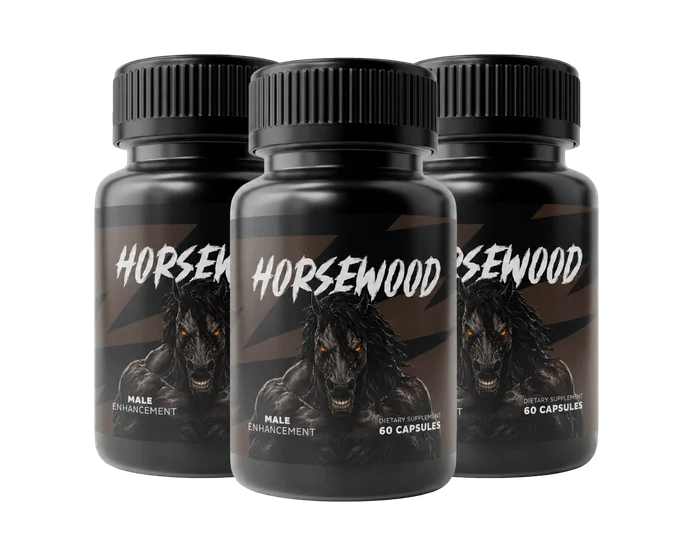
Horsewood is a male vitality formula rather than a gut product — but it is listed the same way we ask of any bottle: every botanical named, with the strength of the evidence for each stated openly.
See the Official StorePrebiotics and fibre: grams, not milligrams
Prebiotics are the substrates your existing bacteria ferment — inulin, fructo-oligosaccharides, galacto-oligosaccharides, partially hydrolysed guar gum. Their research uses doses of roughly three to ten grams a day. A capsule that lists "prebiotic blend 200 mg" is supplying somewhere around a twentieth of that, which is a gesture rather than a dose.
Fibre generally is where the evidence is strongest and the supplement industry is weakest. UK guidance puts adult intake at 30 g a day, and average intakes across the population sit closer to 20 g. Closing that gap through food moves more than any capsule in this category will, and no realistic number of capsules can carry ten grams of fibre.
| Component | Amount used in research | Typical amount in a blend | Evidence strength |
|---|---|---|---|
| Named probiotic strain | 1–10 billion CFU daily | Varies; often undisclosed per strain | Good for specific strains and uses |
| Inulin / FOS | 3–10 g daily | 100–500 mg | Good at trial doses, not at label doses |
| Partially hydrolysed guar gum | 5–6 g daily | Rarely included | Reasonable for regularity |
| Lactase enzyme | Per dairy-containing meal | Usually adequate | Good, for lactose intolerance only |
| Broad "digestive enzyme blend" | No established dose | Proprietary total | Weak for general bloating |
| L-glutamine | 5 g or more daily in studies | Often under 1 g | Limited, mostly clinical populations |
Digestive enzymes: a narrower job than the marketing implies
Enzyme supplements have one clearly supported use and a lot of borrowed credibility. Lactase taken with a dairy-containing meal genuinely helps people who cannot digest lactose; that is well established. Alpha-galactosidase has a reasonable case for the gas that follows beans and pulses.
Beyond those, a broad enzyme blend taken daily for general bloating is not well supported. Healthy people already produce their own digestive enzymes in quantity, and the specific situation in which supplemental pancreatic enzymes are genuinely necessary — pancreatic insufficiency — is a diagnosis with prescription treatment behind it, not something to self-manage from a shelf.
What men over 40 tend to actually need
The searches that lead here — best gut health supplement for men over 40, or something about bloating — usually describe one of three situations, and they call for different things.
If the complaint is irregularity, fibre is the intervention with the strongest evidence and it belongs on the plate before it belongs in a capsule. If the complaint is bloating tied to specific foods, an enzyme aimed at that food is more logical than a broad blend. And if there is genuine irritable bowel syndrome, probiotics have a mixed but real body of evidence, with the honest caveat that trials disagree about which strains help and the effect sizes are modest.
Nutrient absorption is the one place where digestion connects to the rest of male health in a way that is not speculative. A gut that is not absorbing well undermines everything downstream, including the minerals such as zinc, magnesium and vitamin D that get discussed in the vitality context. That is a real link. It is also a much more modest claim than the ones usually made.
A label you can check against published research is worth more than a label with an impressive number on it. Almost every meaningful difference between gut formulas is a disclosure difference, not an ingredient difference.
What a gut supplement cannot do
It cannot treat inflammatory bowel disease, coeliac disease, diverticulitis or any other diagnosed condition, and it is not a substitute for investigating symptoms. Blood in the stool, unexplained weight loss, persistent pain or a change in bowel habit that lasts more than a few weeks are reasons to see a doctor promptly, not reasons to try a different bottle.
It cannot undo a diet. The microbiome responds to what you habitually eat far more than to what you swallow in a capsule, and a daily probiotic alongside very little plant fibre is a strange allocation of effort and money.
And it cannot be assumed to raise testosterone, drive or energy. Research connecting gut bacteria to androgen metabolism exists, but it is largely preclinical and it does not support buying a probiotic for male vitality. That separation is deliberate on this site: the Horsewood formula we cover is described as botanical male vitality support, not digestive support, because those are different claims resting on different evidence. Anyone blurring the two has run ahead of the data — the same problem we describe in our piece on saw palmetto and the prostate, where an ingredient's popularity long outlasted the evidence for it.
A ninety-second label checklist
Run these in order and most products sort themselves out quickly. Is every strain given with a genus, species and identifier? Is the CFU count guaranteed to expiry? Are prebiotics and fibre listed in grams? Is there a third-party testing mark such as NSF, USP or Informed Choice? Does the product state storage conditions, since some strains need refrigeration and some are shelf-stable by design?
Then one judgement question: is there a reason for each ingredient, or is the formula a list assembled to look comprehensive? Fifteen ingredients at token doses is usually a marketing decision. Four ingredients at studied doses is usually a formulation decision, and it is the better bet even though it photographs worse. Applied consistently, that single question separates the best gut health supplements for men from the ones that merely look thorough. It is the same discipline our walkthrough of the Horsewood ingredients label applies on the male-vitality shelf, and once you have picked something, the routine you build around the dose decides whether you are still taking it in eight weeks.
Whatever you conclude about the best gut health daily supplement for your own situation, buy from a source that publishes the full panel and a real returns policy. That matters more than which shelf the bottle came from.
Looking for male vitality rather than digestion?
Horsewood is a daily botanical capsule for stamina, drive and steady energy — seven botanicals plus boron, each listed with the strength of its evidence. Current bundles and the 60-day guarantee are handled by the official store.
Check AvailabilityFrequently asked questions
What should a gut supplement label always show?
Three things. The full designation of every strain, meaning genus, species and the strain identifier rather than just a species name. A CFU count guaranteed to the end of shelf life rather than to the time of manufacture. And any prebiotic or fibre listed in grams, because a fraction of a gram is below the amount used in almost all published research.
Is a higher CFU count better?
Not on its own. The number that matters is the dose that was studied for the specific strain you are taking, and for many strains that sits in the single-digit billions. A product advertising a very large total across a dozen unnamed species tells you about manufacturing volume, not about whether any one of those organisms was ever tested at that amount.
Do men need a different gut supplement than women?
Not on current evidence. Products marketed specifically to men usually contain the same strains as the general version with different packaging, and sometimes an added mineral or botanical. If a product costs more for the male label alone, the difference is in the marketing rather than the formula.
Will a gut supplement improve energy or male vitality?
There is no good human evidence for that. Research linking gut bacteria to hormones is mostly preclinical, and nothing supports buying a probiotic for drive or stamina. The defensible reasons to take one are digestive: bloating, bowel regularity, or symptom support in irritable bowel syndrome, where the evidence is mixed but real.
References
- NIH Office of Dietary Supplements — Probiotics fact sheet for health professionals
- NCCIH (NIH) — Probiotics: what you need to know
- PubMed — Hill et al., ISAPP consensus statement on the scope and appropriate use of the term probiotic (Nat Rev Gastroenterol Hepatol, 2014)
- Harvard T.H. Chan School of Public Health — Fibre
- Mayo Clinic — Prebiotics, probiotics and your health
About Horsewood, the product this site covers
Horsewood is a two-a-day gelatin capsule sold for male vitality, carrying seven openly dosed ingredients — tongkat ali, horny goat weed, saw palmetto, wild yam, sarsaparilla, nettle leaf and boron amino acid chelate — at 60 capsules a bottle. Our Horsewood ingredients, price and official website guide reads the Supplement Facts panel line by line and compares each amount with the amount its supporting trial actually used. The rest of this research library is indexed on the Horsaewood evidence blog.
Affiliate disclosure (FTC 16 CFR Part 255). Horsaewood Media is an independent publisher, not the manufacturer or seller. Links marked “Get Offer” are affiliate links: if you buy through one we may earn a commission at no extra cost to you, and that commission has not changed what this article says about the evidence. FDA statement. These statements have not been evaluated by the Food and Drug Administration. Dietary supplements are not intended to diagnose, treat, cure or prevent any disease. This article is information, not medical advice — see our medical disclaimer.